Thursday, February 20, 2020

Tame Impala: The Slow Rush (2020) (Pop,Rock)

The Slow Rush was a partially apt name. The vibe that is Tame Impala has formulated is largely similar to that of Currents. Though an album about time, there seems to be a larger focus on making the songs as long and arduous while washing them even more in "psychedelic" haze. Most songs are far too drawn out and leave the album feeling much longer than it is. There are some highlights though, It Might Be Time and Is it true have some bright and peppy songwriting and crisper instrumentation. The best song on the album is Lost In Yesterday with its groovy and captivating bass line, and catchy hooks and introspective lyrics it may be one of the best Tame Impala songs. Tame Impala shine when making simpler poppier tracks, the psychedelic odysseys end up feeling long-winded, and flood the album making the sands of time fall way to slow.

Best Tracks: Breathe Deeper, Lost In Yesterday*, Is It True, It Might Be Time


C-


Psychadelic Rock/Pop/Electronic

Thursday, February 6, 2020

The Death of Ivan Ilyich Review

The Death of Ivan Ilyich Leo Tolstoy 
Sad and daunting at times, but relieving and sincere as well. A case study in life. 

Siddhartha Review

Siddhartha Herman Hesse 

Appears simple and is told quite simply and quickly, however, the story becomes very profound, hopeful, sad and insightful.

As a self-help journey book, it is superior to the Alchemist in every way. The story is paced better, the wisdom is not given out like candy but rather develop with their characters, through failures, and insights and the characters and ethos of the book remain memorable.

Sunday, January 12, 2020

3950G Chapter 1

Presocratic philosophers 

Thales (624-546 BC): Famous for astronomical and meteorological predictions. Believed that water was the most important element in the world.
Concept of Psyche then arouse which was first "breath" but then "soul" and now "mind"

Pythagoras (570-495 BC): Left no writings, but attracted a large following emphasizing the regularities of mathematics.

Heraclitus (535-470 BC): Promoted the idea of the unity of opposites, constant change and that fire was the most abundant element in the world.

Zeno (of Elea) (Not to be confused with Zeno of Citium) (490-430 BC): Pondered infinity, had that Achilles-turtle thought experiment. Known for paradoxes.

Protagoras (490-420 BC): Believed it was fruitless to speculate about big questions and we should rather focus on the purely human experience. "Man is the measure of all things"

Hippocrates (460-370 BC): Like Protagoras believed in everyday human concerns. Was a physician who believed in the humoral theory, that health illness and aspects of personality occur because of the compositions of 4 certain liquids called humors. Founded the Hippocratic Corpus an extensive body of medical writings and correctly attributed epilepsy to physical causes in the brain(On the Sacred Disease). Emphasizes moderation and balance and established a platform for observational-based medical practice

Socrates (470-399 BC)
Born to a stonecutter and gave up the life of a stonemason to be a philosopher.
Did not charge much for his services and had followers in Plato and Xenophon 
Was charged with corrupting the Athenian youth and treason against Athens and had to commit suicide.
Expressed beliefs in reincarnation and Nativism through innate knowledge from reincarnates.

Plato (424-347 BC)
Born to an aristocratic family, was known to be large and strong.
Fled Athens when Socrates was executed and eventually came back and founded The Academy 
Was very influential for his ideas on idealism and ideal forms.
Appearance to him was referred as a person's conscious experience of something. Lying behind each appearance lied an ideal form representing the essence of the thing. The ideal behing every sensory experience is called Idealism. 
Allegory of the Cave
The reality vs subjective nature.


Argued that the human psyche was composed of the 3 components
1) Appetites
2)Courage
3)Reason
Each person possesses these in different proportions but most people are the appetites.
 Believed we should have philosopher-kings (Reason) but not a monarchy or democracy rather an oligarchy of Philosopher Kings.

Aristotle (384-322 BC)
Born in Northern Greece, close to Macedonia to a Royal Physician to Alexander the Great's grandfather King Amyntas II. Aristotle likely was a childhood friend of Phillip II. Highly influenced by fathers empirical nature he entered The Academy at 17.
Being a Macedon he was ostracized despite his brilliance in Athens. Eventually, he left Athens and married Pythias in Asia Minor, and was joined by Theophrastus a former student of Plato now a follower of Aristotle who helped him engage in experiments.
Aristotle was then invited back to Macedonia to tutor the young Alexander.
After Alexander became king and conquered most of what he could he helped fund the Lyceum a school for Aristotle.
Helped develop numerous fields such as
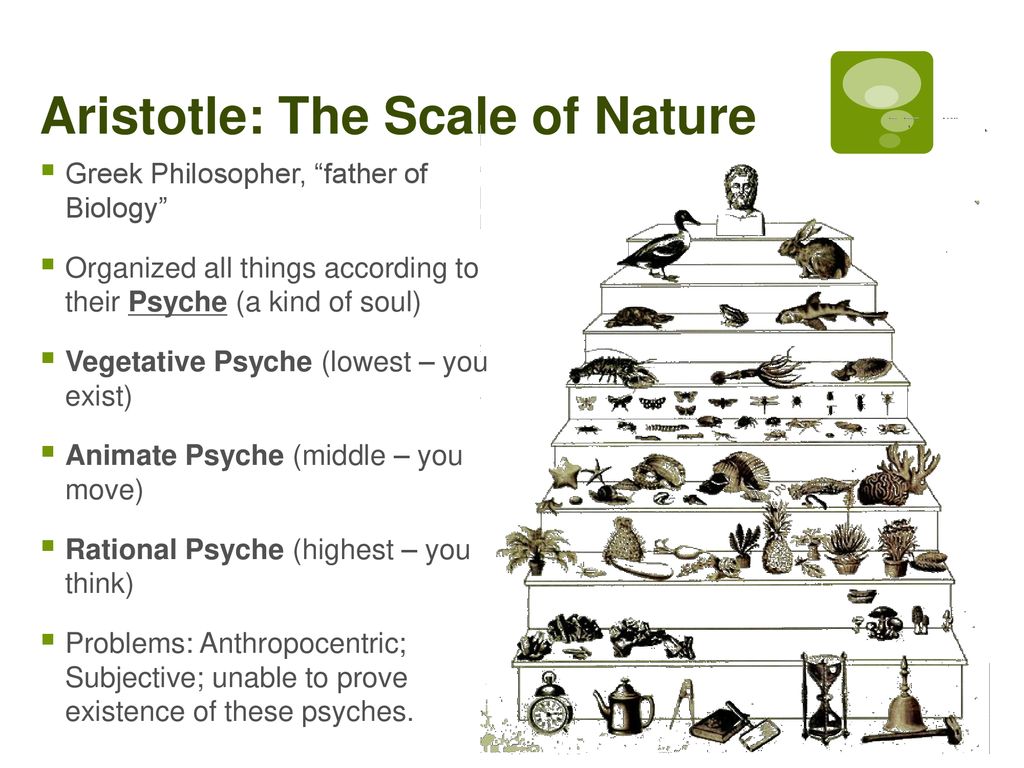
Taxonomy: And created his own Hierarchy of Beings
Scale of Being 
Lowest scale are plants who have 2 important abilities to distinguish themselves
To eat and to reproduce this is known as the Vegetative soul 
Then simple animals have the ability of locomotion and functions of a changing environment Sensation. 
Higher animals have capacity for memory then, even more, develope,imagination.
Animals with all these functions are the sensitive soul. 
Humans are the Rational soul as we are capable of reasoning.

Believed that stimuli leave imprints and memories, established the tabla rasa thought and empiricism. 
Argued that the human psyche has an innate set of categories into which memories are organized


- To Aristotle we had to accumulate facts and do something with them
Rather than the origin the mind was the organizer.

Democritus (460-370 BC) 
-Formulated the Atomic Theory: Stating that there is a limit to the divisibility of all material objects and that they are made of tiny atoms (Atoma means uncuttable in Greek) that move randomly. This theory was attacked as it contradicted the common greek assumption of casuality. 

Causality
All events have a purpose.
Aristotle stated that events had to have 4 components
1) Material Cause: The material things something is made of
2) Formal Cause: The Idea or plan behind something.
3) Efficient Cause: The actions that brought the thing into being
4) Final Cause: The purpose for the creation.

Atomic Theory was largely dismissed but eventually Epicurus (341-270 BC) advocated it.

Later Lucretius (99-55 BC) rekindled the atomic theory in his poem De Rerum Natura 

Islamic Pioneers

Al-Kindi (800-871) 
- Was based in Baghdad and became a leader of the House of Wisdom. Became known as the "philosopher of the Arabs"
Synthesized ideas of Aristotle into the Muslim faith.
Developed Indo-Arabic numerals which allowed for precise calculations and developed algebra.
Number theory arose and distinctions between numbers. Had implications on the theory of Mind.

Alhazen (965-1040) 
Wrote the Book on Optics based on visual experiments.
Proved that vision was a result of objects giving an impression on the eyes not eyes probing and sensing objects. Proved this through his camera obscura experiment showing an inverted image on the other side. Also expanded on the influence of binocular vision and depth perception.

Avicenna (980-1037) 
Born in modern Uzbekistan but spending most of his life in Iran
Became incredibly well versed in medicine and cured a local sultan of an unknown illness at age 18.
Memorized Aristotles teachings
Wrote The Canon of Medicine a volume that suggested not only the most effective cures and identifications of illnesses but also that medicine was an evidence-based practice.a
Also wrote The Book of the Cure a book intended to cover a full range of topics from Aristotle. More of a Cure of Ignorance.
Expanding Aristotle's hierarchy of functions, Avicenna Differentiated exterior and interior senses, exterior senses were basic capacities to receive impressions while interior senses were what we did with these external senses.
Soul has a motivating function "appetite"
Floating man thought experiment came to the conclusion that even with no prior sensory recollection and experience we would still be conscious of the self. (Similar to Descartes)


European reawakening

Leonardo Fibonacci (1170-1240)
Developed Fibonacci sequence from contact with Arabs and their numbering system.

Thomas Aquinas (1225-1274)
Took from Aristotle and developed natural law justifying it for monotheism.


Saturday, January 11, 2020

3950G Study Introduction

Introduction

Studying the history of psychology is greatly important as it

1) Enriches your contemporary understanding of systems and questions that still circulate today. Many questions posed back than have yet to be answered.

2) We are given a sense of perspectivism on ideas that may have thought to have been legit back in time but not so much now. We can more thoroughly examine issues from the past and how certain insights have affected the current context.

3) We develop a Reflexivity a sense of awareness of our own interactions.\


Edwin Boring wrote an early text on his historical account of psychology. Wanted to reinforce psychology as a science. His pupil Robert Watson developed the APA history of psychology division.

Historiography, a collection of theories, writings and media was to be assessed.

Methods of assessing history

Internalism: Focus on development of ideas neglecting social and political factors that shaped them
Externalism: Focus on the external factors that shaped ideas.

Great Man approach
-History is told through the contributions of great people. This approach often is negligible to external factors.

Zeitgeist approach 
- What is referred to as spirit of the times may affect the ideas and help develop them.

Presentism
- Viewing from a present standpoint
Historicism
- Recreating the past as it was actually
Sophisticated presentism 
- Mix of both

Origin myth process
- History is written to make it appear as though we jump from one discovery to the next without a sense of muddiness.

Continuity-Discontinuity debate 
- Did some issues always occur just masked as other issues? And where do we start in history?

Indigenization
- Process whereby local contexts affect the development of psychology

Sunday, January 5, 2020

100 gecs: 1000 gecs (2019) (Electronic, Pop)

A Frankenstein of millennial music trends that is sure to take even the most eclectic listeners by surprise, but not so much in their innovation but rather how they cram genres into songs. Gloves are off as 100 gecs throw dubstep, rock, pop, rap, ska, punk, metal and all kinds of other genre cliches in the same songs. Failing to fully focus on one concept, the strength and weakness of gecs is their willingness to divert music trends by cobbling songs through different genres. This is admirable but at times it just feels like they don't know how to end their songs or feel compelled to challenge the listener in a very tacky, unfocused, forced way, resulting in dubstep swamps and black metal diversions (745 sticky, 800db cloud) which are cool sometimes, I guess. Many of the hooks are extremely catchy and the production is very quirky and as diverse as can be for a homemade studio. A clear ethos of chaos and angst, not unfamiliar to the target audience, is clearly shown in the short 23 minute run time. Though many songs are very entertaining and the nostalgia and novelty of 1000 gecs may be enticing, the album can seem like a collection of concepts blended together with little purpose other than the rebellious envelope-pushing message their music gives, without fully directing these concepts in fully potentiated directions.


Best Tracks: 745 sticky*, money machine*, stupid horse, ringtone*


B-


Bubblegum bass/Experimental Pop 

Wednesday, January 1, 2020

On the Genealogy of Morals Review/Summary

On the Genealogy of Morals Friedrich Nietzsche 

First Nietzsche read. Was profound but not for everyone, largely romantic and contrary to the logical analytical thought of later years. Very literary and historical, largely a philosophy of belief rather than truth, still very interesting.

Essay 1: "Good and Evil", "Good and Bad"


A slave revolt has resulted in the ressentiment of value judgements of what "good" is. The poor, aided by Judeo-Christian values have found a cunning way to wage century-long warfare against the nobles, strong, warriors. The philology shows that "good" actually means "proper" and "strong" not "nice" but this was changed in a slave revolt as stated above to Evil. Bad was originally and still is just "not proper" the opposite of good. Being powerful and strong and individualistic was seen as a sin and EVIL and GOOD was now the humble and meek, traits supposedly found among the slaves (slaves does not mean slaves it just means those subjugated).

According to slaves, masters lack the authority and right to possess the traits of individualism because these traits are evil, look at the seven deadly sins. Much like Hegel notes the goal of the slave is actually not to become the master, but to smother him and surreptitiously value guilt him to his level. He wants the extinction of the "blond beast". The powerful are dammed by religion and the rich and powerful are looked as evil. These value judgements automatically damn humans for their imperfections and seeking of power when they should not.

The man of ressentiment becomes more clever yet needs to lie to himself to keep up the facade. They seek to constrain others power as they are too weak or culturally poisoned to take off their shackles. This man can also be lead to a subtle form of nihilism, through a belief that nothing matters in this world. This man sadly believes himself to be the good man because of the prevalence of these values. But this man is actually weakened from these values and they interpret weakness as freedom and equate that as merit.

Though the slave morality runs rampant in society that does not mean it is all bad and should be stopped. It is just so odd that we humans choose times to condemn power. A morality must be formed that transcends slave and master morality allowing the individual to be a fully autonomous yet respectful being. Cultivating their own sets of proper ethics.


Essay 2: "Guilt""Bad Conscience" and Related Matters.

Before the formation of guilt, humans were governed by transactional relations which had a debtor and a creditor. A consciousnesses becomes branded in memory through a hurt fully long process. However, man becomes forgetful to null the pain and develops a sense of control of the future "memory". This is where promises were created, but the psychological effect of the branding still remains.

The word guilt in German "Schuld" originated from debt "Schulden". Punishment for crimes and "debts" occurs out of anger of harm done. And the creditor can physically harm the debtor, creating a sense of pleasure yet also guilt (Schadenfreude) (Debt -> Guilt).

Once man become conscious of his cruelty he become more pessimistic and mistrusting of life and man. Ashamed of his instincts. The opposite of todays ideals are referenced, with suffering  being an argument against existence when Nietzsche argues the opposite. It is not actually the physical suffering which is the most painful but the meaningless of suffering which is where religion takes center stage, allowing God to invent suffering and self justification of "evil". Communities undergo the same relationship between debtor and creditor as well and as a community becomes stronger the misdemeanors of the individual are not as important, as the community weakens harsher forms of punishment emerge.

 It is interesting as it seems punishment does not undergo what many people would expect its purpose which is to develop remorse. Instead people punished feel alienated. The broad effect of punishment is to increase fear.

Ressentiment also emerges through attempts to justify revenge through justice. To counter this one must impersonal evualte the deed, however this is difficult as legal conditions are biologically wired. Shown through Adaptation>>>Activity. Every instinct that does not vent itself externally turns inwards and against man. A violent separation from mans animal past ensues and Gods condemn us.
Only the bad conscience man the man who mistreats himself fuels this sense of unegoism.


Essay 3: Ascetic Ideals

The ascetic ideal was formulated through a fear in man, a fear of the void.

The ascetic priest introduces morality to the both the warrior and the sick herd. He is capable to invert the ressentiment of the herd back towards themselves, to look to sin rather than ressentiment. He is also capable of making the noble more humble.

The ascetic represents life against life, (fasting, chastity etc). Every philosopher according to Nietzsche was once an ascetic, controlling themselves. The Ascetic ideal is a complex exerting of the Will to Power through both a physiological and psychological warfare against oneself exerting ones originality in the rawest most extreme measure. However this want to be different chains him to be a tool or a door for others. His ideals allow him as a shepherd for the herd to tame them. In order to take care of the sick you must yourself he sick. There is nothing more dangerous to the strong than the sick. The priest defends the herd against the strong, and the herd against himself, the herd through wild ressentiment can also harm the strong. Instead the Priest turns the ressentiment of the herd to themselves, he tells the herd you are the reason that you suffer. In order to combat the guilt and depression the priest introduces new remedies, giving others pleasure (this is a sneaky way to showing your Will to Power), abstaning from pleasure, routines. A bad way we combat this is the "orgy of feeling" in which the an external affect awakens a rush of an intense feeling were the affect takes over.

This ideal takes different forms. But ultimately is a true fundamental contention with life and an embrace of suffering. The ideals of artists need to be propped up by philosophies. Philosophers show the ascetic ideal through the lens of the spectator. Detached and general. The philosopher consciously avoids things that stray him off what he is good at or wants to be.

The priests were the first philosophers, they were contemplative and produced fear in others, controlling. The Warriors feared them a bit (Look at Socrates).

It is natural to avoid what we are bad at, we remain what we are good at and can become mediocre and avoid suffering. Humility, Poverty and Chasity must be controlled in order to change ourselves.
Ascetic priest does not want to master something in life but to master life itself.

To gain true objectivity is not impersonal but rather personal to all, an understanding of all.

The ascetic faith still lingers in philosophy and science. Philosophers and science seek to find values and posit that there is a universal truth at the bottom of life. The will to truth must be an existential problem to the individual.
