David Hume (1711-1776)
- Strong empiricist who believed that every effect has a cause
- Hume argued the true value of this assertion cannot be deduced in a priori fashion,
but only from experience, and only as a subjective necessity
- Hume awakens Kant from his slumbers
Immanuel Kant (1724-1804)
- Critique of Pure Reason
- Perception is an active process, the mind contributes to our reality.
- Kant agrees with empiricists regarding innate ideas not being viable
- However he believes that we have the acquisition of a priori knowledge
Offered a solution of Transcendental Idealism
States that there are two domains of knowledge.
External world: Objects in a state independent of human experience
Inner or phenomenal world: The mind's transformation of the outer world.
The mind localizes its experiences in space and time in intuition
Space: Not an objective, empirical property of the world. No empirical perception can give
us the idea of ’space’. It is the subjective and logical precondition for representation of
objects.
Time: Not an empirical sensation, but a logical, a priori structuring principle. We cannot
represent phenomena without the notion of time, but we can represent time empty of
phenomena, therefore the idea of time is logically necessary.
- Our mind structures the outer world in a way which is interpreted by the inner wold.
- Every perception is
1) Raw Sense Data
2) The organizing and structuring of data by the mind
To experience a (physical) world of objects, we must be able to distinguish the temporal order of
our experiences from the temporal order of events.
Law of Specific nerve energies (Believed in the 19th century)
- Each sensory nerve conveys only one sense which results in consciousness.
Hermann Helmholtz (1821-1894)
- Adopted doctrine of physiological mechanism
Believing that all physiological processes are to be undersood through physical and chemical processes.
Vs
Vitalism
-All living organisms have a nonphysical lifeforce.
Helmholtz believed that energy is conserved and released based on mechanistic principles
- Tested reaction time on frogs (Neural signalling)
Time needed to process signal
1. Sending signal
2. Transmit message to nerves
3. Time required for perception in the brain
Helmholtz began studying vision.
- Physical: Eye as an optical instrument
- Physiological: How an image on the retina conveys signals to the brain (Sensations)
- Psychological: How these sensations could be construed to meaningful perceptions.
Found imperfections in the eye which gave more Creedence to Kant
Developed the trichromatic theory
Helmholtz disagreed with Kant (spatial perception determined mainly by innate intuitions
& categories; Nativism view) and believed sensation was innate but that perceptual
processes are acquired through experience & learning (empiricist idea)
- Helmoltz believed that sensation was innate put perceptual processes are acquired through experience.
Ebbinghaus illusion: Our brain makes judgements about size using adjacent objects.
Helmholtz had 2 important contributions to psychology
1) Neurological processes which underpin mental functions can be studied
2) The mind operates via mechanistic principles to create reality
Fechner (1801-1887)
Showing posts with label 3950G. Show all posts
Showing posts with label 3950G. Show all posts
Friday, March 22, 2024

3950G Chapter 2
Pioneering Philosophers of Mind
Rene Descartes (1596-1650)
Born to a wealthy aristocratic family, Descartes was gifted from a young age.
After finishing his studies at age 16 he claimed to have known everything he could know from books and proceeded to wonder around Paris.
Eventually he came under the guidance of an intellectual monk, Marin Mersenne, who provided intellectual and spiritual support.
Then Descartes engaged in one of his aspirations, though Catholic, he became a mercenary for the Protestant Dutch army.
Descartes then came under the wing of dutch philosopher Isaac Beeckman who helped shape insights in mathematical theory.
Bored by the Protestant cause, Descartes switched sides to the Catholic forces in southern Germany.
Descartes then had a few "Visions"
1) His first concerned analytic geometry with the development of Cartesian coordinates in which he posits that any point in space could be precisely defined by 3 coordinates x,y and z
2) His second was an expansion of his previous findings. Though a skeptic, Descartes tried to prove that his geometrical findings could be applied to nonmathematical fields.
He argued that the most simple properties of the physical world (Simple Natures) were those whose existence could not be analyzed or doubted. Our sensory impressions may seem obvious but maybe incredibly misleading.
He argued that only 2 physical properties were Simple Natures
1) Extension: The occupation of physical space
2) Motion: The movement across physical space
All physical phenomena could be explained in terms of these two properties.
Galileo (1564-1642) proposed a similar finding.
3 Primary qualities: Shape, Quantity and Motion
When the Primary qualities interact with primary qualities of primary qualities of sensory organs then Secondary qualties (sights, sounds etc ) arise.
Descartes was reluctant to publish his works after the arrest of Galileo so much of his work was published after death.
Descartes physics honoured Democritus in the atomic theory. However he denied that atoms moved in a void.
Descarte saw the universe as composed of 3 different kinds of material particles.
One particle leaves no empty space as this space is refilled by other particles.
The 3 kinds of elements are fire, air and earth. Air particles and fire particles were to small to see.
Air particles are between everything and vibrate in a column to account for sight.
In anantomy, Descartes thought the cerebrospinal fluid as being animal spirits and he falsely thought nerves to be hollow and would send animal spirits in responses to tugs initiated by sensory organs. Though false this is very close to how reflexes actually operate.
Descartes also thought that this could be possible via an acquired response from previous stimuli through learning.
Also recognized that external stimuli may affect behaviour through these animal spirits.
In wakefulness these spirits are maximally used, in sleep, they are controlled for the most part.
Much in aline with Aristotle's distinction of souls, Descartes opined that nonhumans could be completely understood through mechanistic terms (Automata).
Humans on the other hand had the capacity for rational much akin to Aristotle's rational soul.
Thinking was the only thing that could not be doubted. "Je pense donc je suis" One's mind is the only thing undoubtable.
Descartes concluded that innate ideas were independent of these sensory experiences but derived from the nature of the thinking soul.
3 innate ideas: My finite thinking, God, and my body.
This sharp distinction between mind and body is referred as dualism.
Added that the important phenomena are the result of an interaction between mind and body.
Commonly referred to as interactive dualism.
Princess Elizabeth of Bohemia (1618-1680) was a correspondent of Descartes who proved to be philosophically knowledgable in her own right, questioning his theory of mind and body and how an immaterial mind could interact with a material soul.
- Descartes response was that a body without a soul is under complete mechanistic control of external stimuli while a soul without a body would be conscious, but only of its innate ideas (Avicenna's floating man).
Speculated that the pineal gland was where sensations from the divided body were unified.
The mind's conscious experiences of these spirits are called the passions.
John Locke and the Empiricists
Locke adopted many of Descartes ideas but based them into an empiricist theory.
- Did not accept Descartes idea of innate ideas and denied that the mind is always active.
Locke was influenced by the intellectual atmosphere of his time and became a follower of Robert Boyle
- Eventually befriended the lord Sir Anthony Ashley Cooper through being his personal physician.
Soon Cooper committed treason against Charles II by declaring the parliament should not allow the younger catholic brother James to succeed. Locke had to flee due to his relations with Cooper and went to Holland under the pseudonym Dr. van der Linden.
Locke Published An Essay Concerning Human Understanding in which he professed his empiricist "Tabla rasa" views stating that experience is how all knowledge is founded.
The mind has 2 types of experiences
Sensations: Of objects of the external world
Reflections: Of the mind's own operations, produce memories
Immediate knowledge is reffered to as intuitive knowledge
Demonstrative knowledge is found through reasoning
Sensitive knowledge (the largest according to Locke) Is composed of patterns and experiences.
Association of ideas Is the linking or combining of ideas
First we produce simple ideas and after experience we produce complex ideas.
Locke expanded on Hobbes's ideas that society is formed merely through social constructs but that social constructs were positive and rational.
Leibniz (1646-1716)
Developed a mathematical calculating machine, binary arithmetic, and infinitesimal calculus.
Disagreed with Locke and Descartes
-Leibniz stated that the world was not made of inanimate particles but rather animate ones called monads.
-The most numerous were bare monads who had the least amount of awarness. Comparable to people in deep sleep.
Then a level higher were sentient monads with capacities for sensation and perception of material objects and memory
- Higher were rational monads capable of becoming the soul or mind
Apperception: Was the consciousness of the rational monads
Rene Descartes (1596-1650)
Born to a wealthy aristocratic family, Descartes was gifted from a young age.
After finishing his studies at age 16 he claimed to have known everything he could know from books and proceeded to wonder around Paris.
Eventually he came under the guidance of an intellectual monk, Marin Mersenne, who provided intellectual and spiritual support.
Then Descartes engaged in one of his aspirations, though Catholic, he became a mercenary for the Protestant Dutch army.
Descartes then came under the wing of dutch philosopher Isaac Beeckman who helped shape insights in mathematical theory.
Bored by the Protestant cause, Descartes switched sides to the Catholic forces in southern Germany.
Descartes then had a few "Visions"
1) His first concerned analytic geometry with the development of Cartesian coordinates in which he posits that any point in space could be precisely defined by 3 coordinates x,y and z
2) His second was an expansion of his previous findings. Though a skeptic, Descartes tried to prove that his geometrical findings could be applied to nonmathematical fields.
He argued that the most simple properties of the physical world (Simple Natures) were those whose existence could not be analyzed or doubted. Our sensory impressions may seem obvious but maybe incredibly misleading.
He argued that only 2 physical properties were Simple Natures
1) Extension: The occupation of physical space
2) Motion: The movement across physical space
All physical phenomena could be explained in terms of these two properties.
Galileo (1564-1642) proposed a similar finding.
3 Primary qualities: Shape, Quantity and Motion
When the Primary qualities interact with primary qualities of primary qualities of sensory organs then Secondary qualties (sights, sounds etc ) arise.
Descartes was reluctant to publish his works after the arrest of Galileo so much of his work was published after death.
Descartes physics honoured Democritus in the atomic theory. However he denied that atoms moved in a void.
Descarte saw the universe as composed of 3 different kinds of material particles.
One particle leaves no empty space as this space is refilled by other particles.
The 3 kinds of elements are fire, air and earth. Air particles and fire particles were to small to see.
Air particles are between everything and vibrate in a column to account for sight.
In anantomy, Descartes thought the cerebrospinal fluid as being animal spirits and he falsely thought nerves to be hollow and would send animal spirits in responses to tugs initiated by sensory organs. Though false this is very close to how reflexes actually operate.
Descartes also thought that this could be possible via an acquired response from previous stimuli through learning.
Also recognized that external stimuli may affect behaviour through these animal spirits.
In wakefulness these spirits are maximally used, in sleep, they are controlled for the most part.
Much in aline with Aristotle's distinction of souls, Descartes opined that nonhumans could be completely understood through mechanistic terms (Automata).
Humans on the other hand had the capacity for rational much akin to Aristotle's rational soul.
Thinking was the only thing that could not be doubted. "Je pense donc je suis" One's mind is the only thing undoubtable.
Descartes concluded that innate ideas were independent of these sensory experiences but derived from the nature of the thinking soul.
3 innate ideas: My finite thinking, God, and my body.
This sharp distinction between mind and body is referred as dualism.
Added that the important phenomena are the result of an interaction between mind and body.
Commonly referred to as interactive dualism.
Princess Elizabeth of Bohemia (1618-1680) was a correspondent of Descartes who proved to be philosophically knowledgable in her own right, questioning his theory of mind and body and how an immaterial mind could interact with a material soul.
- Descartes response was that a body without a soul is under complete mechanistic control of external stimuli while a soul without a body would be conscious, but only of its innate ideas (Avicenna's floating man).
Speculated that the pineal gland was where sensations from the divided body were unified.
The mind's conscious experiences of these spirits are called the passions.
John Locke and the Empiricists
Locke adopted many of Descartes ideas but based them into an empiricist theory.
- Did not accept Descartes idea of innate ideas and denied that the mind is always active.
Locke was influenced by the intellectual atmosphere of his time and became a follower of Robert Boyle
- Eventually befriended the lord Sir Anthony Ashley Cooper through being his personal physician.
Soon Cooper committed treason against Charles II by declaring the parliament should not allow the younger catholic brother James to succeed. Locke had to flee due to his relations with Cooper and went to Holland under the pseudonym Dr. van der Linden.
Locke Published An Essay Concerning Human Understanding in which he professed his empiricist "Tabla rasa" views stating that experience is how all knowledge is founded.
The mind has 2 types of experiences
Sensations: Of objects of the external world
Reflections: Of the mind's own operations, produce memories
Immediate knowledge is reffered to as intuitive knowledge
Demonstrative knowledge is found through reasoning
Sensitive knowledge (the largest according to Locke) Is composed of patterns and experiences.
Association of ideas Is the linking or combining of ideas
First we produce simple ideas and after experience we produce complex ideas.
Locke expanded on Hobbes's ideas that society is formed merely through social constructs but that social constructs were positive and rational.
Leibniz (1646-1716)
Developed a mathematical calculating machine, binary arithmetic, and infinitesimal calculus.
Disagreed with Locke and Descartes
-Leibniz stated that the world was not made of inanimate particles but rather animate ones called monads.
-The most numerous were bare monads who had the least amount of awarness. Comparable to people in deep sleep.
Then a level higher were sentient monads with capacities for sensation and perception of material objects and memory
- Higher were rational monads capable of becoming the soul or mind
Apperception: Was the consciousness of the rational monads
God was the Supreme Monad and humans could dimly appreciate this (ALA Spinoza)
Because of this Leibniz is refered as a rationalist.
Ideas are innate to us he believed these are necessary truths
Consciousness was formed through minute perceptions of these monads
Locke's views became incredibly important especially in England
There they became known as British associationism
George Berkley then used Lockes approach to analyze depth perception through and empiricist view.
David Hartley argued that ideas are the subjective results of minute vibrtions in specific locations of the brain.
Wednesday, March 4, 2020
3905G Chapter 3
Chapter 3 Physiologists of Mind
Franz Josef Gall (1758-1828)
- Built on earlier work of Thomas Willis
- Was one of the first scientists to look at the brain as a complex organ
- Willis Observed that brain 2 kinds of substances, gray matter (outer surfaces of the brain) and white matter.
- Willis believed that the white matter contained spirits generated in the gray matter and correctly described blood vessels in the brain.
-Gall correctly identified commissures, that the two halves of the brain are interconnected by white matter. This helped explain why damage to one side would lead to effects on the other.
These findings laid the groudwork for the later discovery that the brain and spinal cord are composed of neurons.
-Gall was also one of the first comparative brain anatomists and developed phrenology. Believing that parts of the skull could properly identify different faculties and traits.
Used empirical observations to make deductions and proposed 27 faculties called organs.
Pierre Flourens (1794-1867)
- Aimed to use more rigorous scientific methods to understand brain functions
Ablation (Removal part of brain or lesions), then studied functions and regeneration.
Found that ablation of cerebellum=motor loss, and cerebral cortex=lost will
-Proposed that the cortex and cerebellum had specific functions (action proper) but they interacted to function as a whole (action commune)
- The proposed idea of brain plasticity
Paul Broca (1824-1880)
- A patient of Broca's named Tan had a lesion on the left frontal hemisphere which caused a lack of speech production, although comprehension was intact. Later Tan began losing sense of his right arm and leg.
Broca's aphasia: Loss of proudction of speech caused by damage to the left frontal hemisphere (Broca's Area) also known as motor aphasia
Gustav Fritsch (1837-1927) and Eduard Hitzing (1838-1907)
- Studied if brain responded to electrical stimulation i
- Shocking animals brains etc
David Ferrier
- Stimulated occipital lobe and found loss of vision.
- Also located the temporal lobe and sensory strip
Ideas emerged such as interconnected (association) areas and importance of white matter.

Carl Wernicke (1848-1905)
Described sensory aphasia also known as Wernicke's aphasia
- The ability to produce speech but not understand (receptive) language.
- Will repeat and have issues with comprehension, paraphasias
Shepard Ivory Franz (1874-1933)
- Found that cats that had previously solved a puzzle forgot the responses only when the frontal regions were ablated. Sometimes frontally ablated animals were able to relearn the escape response
Karl Lashley (1890-1958)
-Refuted localization and though that memories were contained within cortex widely.
-Said it was important the size of the ablation and the difficulty of the maze.
Built on Flourens's concept of action commune
Espoused Equipotentiality (Brain plasticity, neural regions take over)
Wilder Penfield (1891-1976)
- Located the region of the epileptic seizure through gentle stimulation and removed regions
Brenda Milner (1918-)
- Did work with HM
- HM had seizures and had medial temporal lobe severed and parts of hippocampus
- Seizures stopped but had severe anterograde amnesia (developing new memories)
- Had impared encoding and storage, declarative memory also impaired
- Findings showed that memory is a distinct cerebral function
- Showed that medial aspect of temporal lobe is important for memory
- Findings showed that hippocampus and temporal lobe stored memories.
Franz Josef Gall (1758-1828)
- Built on earlier work of Thomas Willis
- Was one of the first scientists to look at the brain as a complex organ
- Willis Observed that brain 2 kinds of substances, gray matter (outer surfaces of the brain) and white matter.
- Willis believed that the white matter contained spirits generated in the gray matter and correctly described blood vessels in the brain.
-Gall correctly identified commissures, that the two halves of the brain are interconnected by white matter. This helped explain why damage to one side would lead to effects on the other.
These findings laid the groudwork for the later discovery that the brain and spinal cord are composed of neurons.
-Gall was also one of the first comparative brain anatomists and developed phrenology. Believing that parts of the skull could properly identify different faculties and traits.
Used empirical observations to make deductions and proposed 27 faculties called organs.
Pierre Flourens (1794-1867)
- Aimed to use more rigorous scientific methods to understand brain functions
Ablation (Removal part of brain or lesions), then studied functions and regeneration.
Found that ablation of cerebellum=motor loss, and cerebral cortex=lost will
-Proposed that the cortex and cerebellum had specific functions (action proper) but they interacted to function as a whole (action commune)
- The proposed idea of brain plasticity
Paul Broca (1824-1880)
- A patient of Broca's named Tan had a lesion on the left frontal hemisphere which caused a lack of speech production, although comprehension was intact. Later Tan began losing sense of his right arm and leg.
Broca's aphasia: Loss of proudction of speech caused by damage to the left frontal hemisphere (Broca's Area) also known as motor aphasia
Gustav Fritsch (1837-1927) and Eduard Hitzing (1838-1907)
- Studied if brain responded to electrical stimulation i
- Shocking animals brains etc
David Ferrier
- Stimulated occipital lobe and found loss of vision.
- Also located the temporal lobe and sensory strip
Ideas emerged such as interconnected (association) areas and importance of white matter.

Carl Wernicke (1848-1905)
Described sensory aphasia also known as Wernicke's aphasia
- The ability to produce speech but not understand (receptive) language.
- Will repeat and have issues with comprehension, paraphasias
Shepard Ivory Franz (1874-1933)
- Found that cats that had previously solved a puzzle forgot the responses only when the frontal regions were ablated. Sometimes frontally ablated animals were able to relearn the escape response
Karl Lashley (1890-1958)
-Refuted localization and though that memories were contained within cortex widely.
-Said it was important the size of the ablation and the difficulty of the maze.
Built on Flourens's concept of action commune
Espoused Equipotentiality (Brain plasticity, neural regions take over)
Wilder Penfield (1891-1976)
- Located the region of the epileptic seizure through gentle stimulation and removed regions
Brenda Milner (1918-)
- Did work with HM
- HM had seizures and had medial temporal lobe severed and parts of hippocampus
- Seizures stopped but had severe anterograde amnesia (developing new memories)
- Had impared encoding and storage, declarative memory also impaired
- Findings showed that memory is a distinct cerebral function
- Showed that medial aspect of temporal lobe is important for memory
- Findings showed that hippocampus and temporal lobe stored memories.
Sunday, January 12, 2020
3950G Chapter 1
Presocratic philosophers
Thales (624-546 BC): Famous for astronomical and meteorological predictions. Believed that water was the most important element in the world.
Concept of Psyche then arouse which was first "breath" but then "soul" and now "mind"
Pythagoras (570-495 BC): Left no writings, but attracted a large following emphasizing the regularities of mathematics.
Heraclitus (535-470 BC): Promoted the idea of the unity of opposites, constant change and that fire was the most abundant element in the world.
Zeno (of Elea) (Not to be confused with Zeno of Citium) (490-430 BC): Pondered infinity, had that Achilles-turtle thought experiment. Known for paradoxes.
Protagoras (490-420 BC): Believed it was fruitless to speculate about big questions and we should rather focus on the purely human experience. "Man is the measure of all things"
Hippocrates (460-370 BC): Like Protagoras believed in everyday human concerns. Was a physician who believed in the humoral theory, that health illness and aspects of personality occur because of the compositions of 4 certain liquids called humors. Founded the Hippocratic Corpus an extensive body of medical writings and correctly attributed epilepsy to physical causes in the brain(On the Sacred Disease). Emphasizes moderation and balance and established a platform for observational-based medical practice
Socrates (470-399 BC)
Born to a stonecutter and gave up the life of a stonemason to be a philosopher.
Did not charge much for his services and had followers in Plato and Xenophon
Was charged with corrupting the Athenian youth and treason against Athens and had to commit suicide.
Expressed beliefs in reincarnation and Nativism through innate knowledge from reincarnates.
Plato (424-347 BC)
Born to an aristocratic family, was known to be large and strong.
Fled Athens when Socrates was executed and eventually came back and founded The Academy
Was very influential for his ideas on idealism and ideal forms.
:max_bytes(150000):strip_icc()/GettyImages-11410491702-07f03ccd0eb54d36a9b62212cd2f55a1.jpg) Appearance to him was referred as a person's conscious experience of something. Lying behind each appearance lied an ideal form representing the essence of the thing. The ideal behing every sensory experience is called Idealism.
Appearance to him was referred as a person's conscious experience of something. Lying behind each appearance lied an ideal form representing the essence of the thing. The ideal behing every sensory experience is called Idealism.
Allegory of the Cave
- The reality vs subjective nature.
Argued that the human psyche was composed of the 3 components
1) Appetites
2)Courage
3)Reason
Each person possesses these in different proportions but most people are the appetites.
Believed we should have philosopher-kings (Reason) but not a monarchy or democracy rather an oligarchy of Philosopher Kings.
Aristotle (384-322 BC)
Born in Northern Greece, close to Macedonia to a Royal Physician to Alexander the Great's grandfather King Amyntas II. Aristotle likely was a childhood friend of Phillip II. Highly influenced by fathers empirical nature he entered The Academy at 17.
Being a Macedon he was ostracized despite his brilliance in Athens. Eventually, he left Athens and married Pythias in Asia Minor, and was joined by Theophrastus a former student of Plato now a follower of Aristotle who helped him engage in experiments.
Aristotle was then invited back to Macedonia to tutor the young Alexander.
After Alexander became king and conquered most of what he could he helped fund the Lyceum a school for Aristotle.
Helped develop numerous fields such as
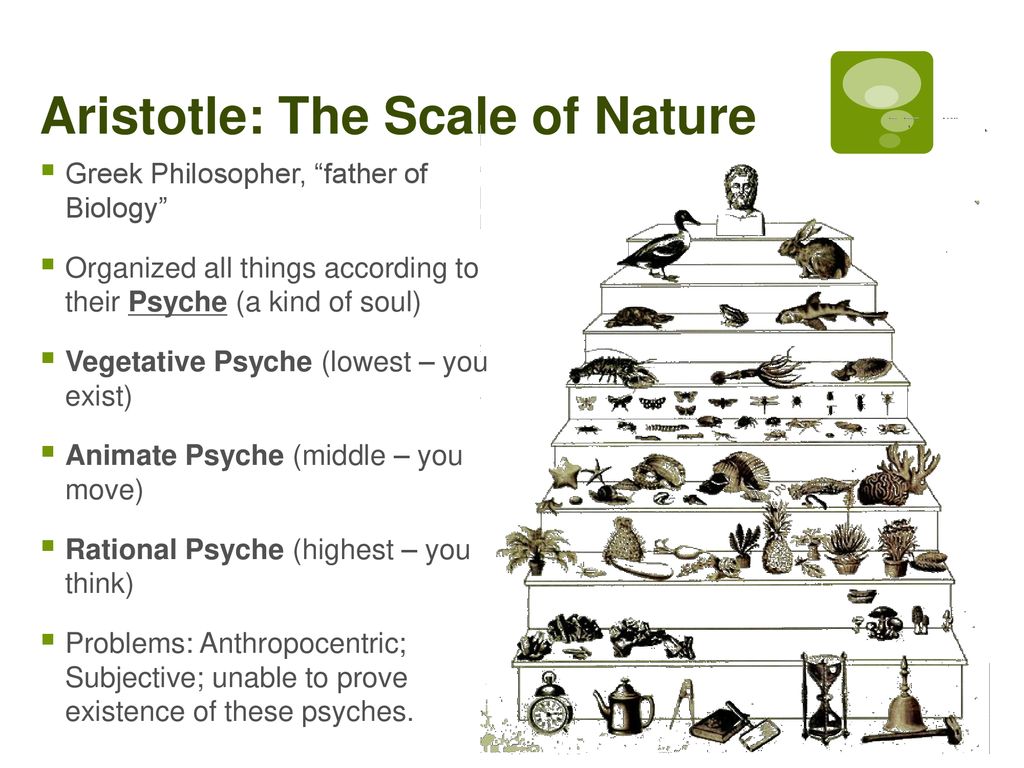 Taxonomy: And created his own Hierarchy of Beings
Scale of Being
Lowest scale are plants who have 2 important abilities to distinguish themselves
To eat and to reproduce this is known as the Vegetative soul
Then simple animals have the ability of locomotion and functions of a changing environment Sensation.
Higher animals have capacity for memory then, even more, develope,imagination.
Animals with all these functions are the sensitive soul.
Humans are the Rational soul as we are capable of reasoning.
Believed that stimuli leave imprints and memories, established the tabla rasa thought and empiricism.
Argued that the human psyche has an innate set of categories into which memories are organized
- To Aristotle we had to accumulate facts and do something with them
Rather than the origin the mind was the organizer.
Democritus (460-370 BC)
-Formulated the Atomic Theory: Stating that there is a limit to the divisibility of all material objects and that they are made of tiny atoms (Atoma means uncuttable in Greek) that move randomly. This theory was attacked as it contradicted the common greek assumption of casuality.
Causality
All events have a purpose.
Aristotle stated that events had to have 4 components
1) Material Cause: The material things something is made of
2) Formal Cause: The Idea or plan behind something.
3) Efficient Cause: The actions that brought the thing into being
4) Final Cause: The purpose for the creation.
Atomic Theory was largely dismissed but eventually Epicurus (341-270 BC) advocated it.
Later Lucretius (99-55 BC) rekindled the atomic theory in his poem De Rerum Natura
Islamic Pioneers
Al-Kindi (800-871)
- Was based in Baghdad and became a leader of the House of Wisdom. Became known as the "philosopher of the Arabs"
Synthesized ideas of Aristotle into the Muslim faith.
Developed Indo-Arabic numerals which allowed for precise calculations and developed algebra.
Number theory arose and distinctions between numbers. Had implications on the theory of Mind.

Alhazen (965-1040)
Wrote the Book on Optics based on visual experiments.
Proved that vision was a result of objects giving an impression on the eyes not eyes probing and sensing objects. Proved this through his camera obscura experiment showing an inverted image on the other side. Also expanded on the influence of binocular vision and depth perception.
Avicenna (980-1037)
Born in modern Uzbekistan but spending most of his life in Iran
Became incredibly well versed in medicine and cured a local sultan of an unknown illness at age 18.
Memorized Aristotles teachings
Wrote The Canon of Medicine a volume that suggested not only the most effective cures and identifications of illnesses but also that medicine was an evidence-based practice.a
Also wrote The Book of the Cure a book intended to cover a full range of topics from Aristotle. More of a Cure of Ignorance.
Expanding Aristotle's hierarchy of functions, Avicenna Differentiated exterior and interior senses, exterior senses were basic capacities to receive impressions while interior senses were what we did with these external senses.
Soul has a motivating function "appetite"
Floating man thought experiment came to the conclusion that even with no prior sensory recollection and experience we would still be conscious of the self. (Similar to Descartes)
European reawakening
Leonardo Fibonacci (1170-1240)
Developed Fibonacci sequence from contact with Arabs and their numbering system.
Thomas Aquinas (1225-1274)
Took from Aristotle and developed natural law justifying it for monotheism.
Thales (624-546 BC): Famous for astronomical and meteorological predictions. Believed that water was the most important element in the world.
Concept of Psyche then arouse which was first "breath" but then "soul" and now "mind"
Pythagoras (570-495 BC): Left no writings, but attracted a large following emphasizing the regularities of mathematics.
Heraclitus (535-470 BC): Promoted the idea of the unity of opposites, constant change and that fire was the most abundant element in the world.
Zeno (of Elea) (Not to be confused with Zeno of Citium) (490-430 BC): Pondered infinity, had that Achilles-turtle thought experiment. Known for paradoxes.
Protagoras (490-420 BC): Believed it was fruitless to speculate about big questions and we should rather focus on the purely human experience. "Man is the measure of all things"
Hippocrates (460-370 BC): Like Protagoras believed in everyday human concerns. Was a physician who believed in the humoral theory, that health illness and aspects of personality occur because of the compositions of 4 certain liquids called humors. Founded the Hippocratic Corpus an extensive body of medical writings and correctly attributed epilepsy to physical causes in the brain(On the Sacred Disease). Emphasizes moderation and balance and established a platform for observational-based medical practice
Socrates (470-399 BC)
Born to a stonecutter and gave up the life of a stonemason to be a philosopher.
Did not charge much for his services and had followers in Plato and Xenophon
Was charged with corrupting the Athenian youth and treason against Athens and had to commit suicide.
Expressed beliefs in reincarnation and Nativism through innate knowledge from reincarnates.
Plato (424-347 BC)
Born to an aristocratic family, was known to be large and strong.
Fled Athens when Socrates was executed and eventually came back and founded The Academy
Was very influential for his ideas on idealism and ideal forms.
Appearance to him was referred as a person's conscious experience of something. Lying behind each appearance lied an ideal form representing the essence of the thing. The ideal behing every sensory experience is called Idealism. Allegory of the Cave
- The reality vs subjective nature.
Argued that the human psyche was composed of the 3 components
1) Appetites
2)Courage
3)Reason
Each person possesses these in different proportions but most people are the appetites.
Believed we should have philosopher-kings (Reason) but not a monarchy or democracy rather an oligarchy of Philosopher Kings.
Aristotle (384-322 BC)
Born in Northern Greece, close to Macedonia to a Royal Physician to Alexander the Great's grandfather King Amyntas II. Aristotle likely was a childhood friend of Phillip II. Highly influenced by fathers empirical nature he entered The Academy at 17.
Being a Macedon he was ostracized despite his brilliance in Athens. Eventually, he left Athens and married Pythias in Asia Minor, and was joined by Theophrastus a former student of Plato now a follower of Aristotle who helped him engage in experiments.
Aristotle was then invited back to Macedonia to tutor the young Alexander.
After Alexander became king and conquered most of what he could he helped fund the Lyceum a school for Aristotle.
Helped develop numerous fields such as
Taxonomy: And created his own Hierarchy of BeingsScale of Being
Lowest scale are plants who have 2 important abilities to distinguish themselves
To eat and to reproduce this is known as the Vegetative soul
Then simple animals have the ability of locomotion and functions of a changing environment Sensation.
Higher animals have capacity for memory then, even more, develope,imagination.
Animals with all these functions are the sensitive soul.
Humans are the Rational soul as we are capable of reasoning.
Believed that stimuli leave imprints and memories, established the tabla rasa thought and empiricism.
Argued that the human psyche has an innate set of categories into which memories are organized
- To Aristotle we had to accumulate facts and do something with them
Rather than the origin the mind was the organizer.
Democritus (460-370 BC)
-Formulated the Atomic Theory: Stating that there is a limit to the divisibility of all material objects and that they are made of tiny atoms (Atoma means uncuttable in Greek) that move randomly. This theory was attacked as it contradicted the common greek assumption of casuality.
Causality
All events have a purpose.
Aristotle stated that events had to have 4 components
1) Material Cause: The material things something is made of
2) Formal Cause: The Idea or plan behind something.
3) Efficient Cause: The actions that brought the thing into being
4) Final Cause: The purpose for the creation.
Atomic Theory was largely dismissed but eventually Epicurus (341-270 BC) advocated it.
Later Lucretius (99-55 BC) rekindled the atomic theory in his poem De Rerum Natura
Islamic Pioneers
Al-Kindi (800-871)
- Was based in Baghdad and became a leader of the House of Wisdom. Became known as the "philosopher of the Arabs"
Synthesized ideas of Aristotle into the Muslim faith.
Developed Indo-Arabic numerals which allowed for precise calculations and developed algebra.
Number theory arose and distinctions between numbers. Had implications on the theory of Mind.

Alhazen (965-1040)
Wrote the Book on Optics based on visual experiments.
Proved that vision was a result of objects giving an impression on the eyes not eyes probing and sensing objects. Proved this through his camera obscura experiment showing an inverted image on the other side. Also expanded on the influence of binocular vision and depth perception.
Avicenna (980-1037)
Born in modern Uzbekistan but spending most of his life in Iran
Became incredibly well versed in medicine and cured a local sultan of an unknown illness at age 18.
Memorized Aristotles teachings
Wrote The Canon of Medicine a volume that suggested not only the most effective cures and identifications of illnesses but also that medicine was an evidence-based practice.a
Also wrote The Book of the Cure a book intended to cover a full range of topics from Aristotle. More of a Cure of Ignorance.
Expanding Aristotle's hierarchy of functions, Avicenna Differentiated exterior and interior senses, exterior senses were basic capacities to receive impressions while interior senses were what we did with these external senses.
Soul has a motivating function "appetite"
Floating man thought experiment came to the conclusion that even with no prior sensory recollection and experience we would still be conscious of the self. (Similar to Descartes)
European reawakening
Leonardo Fibonacci (1170-1240)
Developed Fibonacci sequence from contact with Arabs and their numbering system.
Thomas Aquinas (1225-1274)
Took from Aristotle and developed natural law justifying it for monotheism.
Saturday, January 11, 2020
3950G Study Introduction
Introduction
Studying the history of psychology is greatly important as it
1) Enriches your contemporary understanding of systems and questions that still circulate today. Many questions posed back than have yet to be answered.
2) We are given a sense of perspectivism on ideas that may have thought to have been legit back in time but not so much now. We can more thoroughly examine issues from the past and how certain insights have affected the current context.
3) We develop a Reflexivity a sense of awareness of our own interactions.\
Edwin Boring wrote an early text on his historical account of psychology. Wanted to reinforce psychology as a science. His pupil Robert Watson developed the APA history of psychology division.
Historiography, a collection of theories, writings and media was to be assessed.
Methods of assessing history
Internalism: Focus on development of ideas neglecting social and political factors that shaped them
Externalism: Focus on the external factors that shaped ideas.
Great Man approach
-History is told through the contributions of great people. This approach often is negligible to external factors.
Zeitgeist approach
- What is referred to as spirit of the times may affect the ideas and help develop them.
Presentism
- Viewing from a present standpoint
Historicism
- Recreating the past as it was actually
Sophisticated presentism
- Mix of both
Origin myth process
- History is written to make it appear as though we jump from one discovery to the next without a sense of muddiness.
Continuity-Discontinuity debate
- Did some issues always occur just masked as other issues? And where do we start in history?
Indigenization
- Process whereby local contexts affect the development of psychology
Studying the history of psychology is greatly important as it
1) Enriches your contemporary understanding of systems and questions that still circulate today. Many questions posed back than have yet to be answered.
2) We are given a sense of perspectivism on ideas that may have thought to have been legit back in time but not so much now. We can more thoroughly examine issues from the past and how certain insights have affected the current context.
3) We develop a Reflexivity a sense of awareness of our own interactions.\
Edwin Boring wrote an early text on his historical account of psychology. Wanted to reinforce psychology as a science. His pupil Robert Watson developed the APA history of psychology division.
Historiography, a collection of theories, writings and media was to be assessed.
Methods of assessing history
Internalism: Focus on development of ideas neglecting social and political factors that shaped them
Externalism: Focus on the external factors that shaped ideas.
Great Man approach
-History is told through the contributions of great people. This approach often is negligible to external factors.
Zeitgeist approach
- What is referred to as spirit of the times may affect the ideas and help develop them.
Presentism
- Viewing from a present standpoint
Historicism
- Recreating the past as it was actually
Sophisticated presentism
- Mix of both
Origin myth process
- History is written to make it appear as though we jump from one discovery to the next without a sense of muddiness.
Continuity-Discontinuity debate
- Did some issues always occur just masked as other issues? And where do we start in history?
Indigenization
- Process whereby local contexts affect the development of psychology
Subscribe to:
Posts (Atom)
-
With excellent production helmed by Whitearmor, Bladee continues his trend of art-pop, rap fusions. Some poppier tracks that surely borrow...
-
A Clash of Kings George R.R. Martin I really got into this one. The first half is a bit slow but that is expected as the last book ended...
-
The Alchemist Paulo Coelho A simple story packed with specks of self-help advice. At times the story is captivating, the first ten pages...
